
By Dr. Spandana Nallapati, MD Board-Certified Behavioral Pediatrician
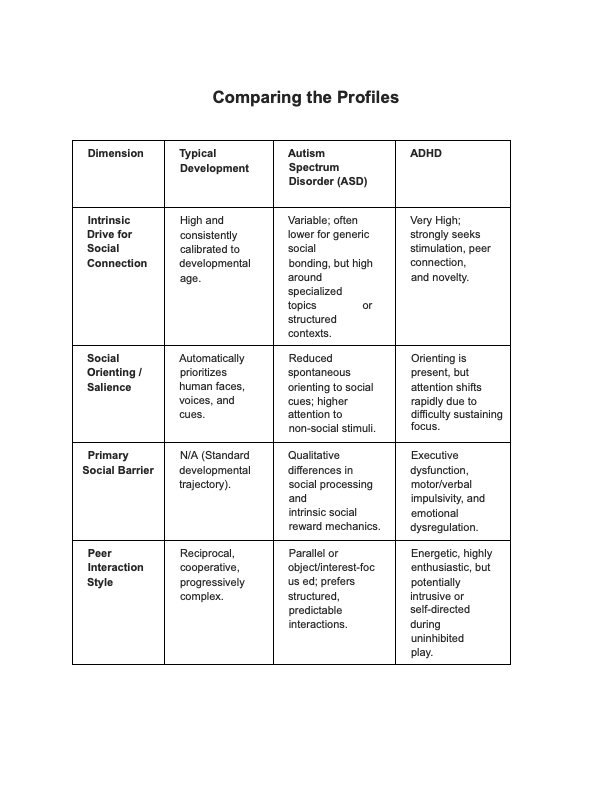
Unlike ASD, where social orienting and social reward valuation are primarily altered, children
with ADHD typically possess high social motivation. However, their ability to execute social
goals is often hindered by underlying executive dysfunction, impulsivity, and reward-processing differences.
● High Approach Motivation: Children with ADHD are often drawn to social situations
and actively seek peer interaction, excitement, and novelty.
● Dopamine-Driven Reward Seeking: Due to differences in dopamine pathway
regulation, children with ADHD require higher levels of stimulation. In social settings, this
can manifest as talkativeness, interrupting, or intrusive play behavior to keep interactions
stimulating.
● Performance Deficit, Not Knowledge Deficit: Children with ADHD often know what
social rules exist, but struggle in real time to inhibit impulses, read subtle non-verbal
cues, or modulate their energy level to match the social context.
● Social Rejection & RSD: Because their social approach can sometimes overwhelm
peers, children with ADHD frequently face negative peer feedback. Over time, this can
trigger Rejection Sensitive Dysphoria (RSD) or secondary social anxiety, where high
social motivation becomes paired with fear of failure or avoidance.
What does this mean for your kids?
Understanding social motivation helps us to make tailored interventions effectively:
● Whether they’re neurotypical or neurodiverse, understanding that there is no “one size
fits all” activity for them simply based on their age, gender and/or diagnosis is a key first
step in trying to figure out their social motivation.
● Honor the fact that neurotypical and neurodivergent communication styles differ
drastically. Knowing how to speak with your child and knowing what will get them to
listen is important. Rewards of various kinds could be one of the many motivators but
those rewards can slowly be taken away as the incentivized motivation starts to become
internal motivation.
● Understand that it isn’t always as simple as “just find what they love”. It takes some
difficult conversations and in the end to understand the inner workings of your child’s
social motivation. It will feel like you’ve exhausted your lists and go to’s or that they seem
to say no to everything.
● Not everything needs to be functional or a type of therapy. Social motivation growth
comes from the most surprising sources. A dungeons and dragons summer camp? Art
camp? It isn’t always the obvious after school activity that could turn your kid’s inner fire.
References
1. American Psychiatric Association. (2013). Diagnostic and statistical manual of mental
disorders (5th ed.). Washington, DC: American Psychiatric Publishing.
2. Chevallier, C., Kohls, G., Troiani, V., Brodkin, E. S., & Schultz, R. T. (2012). The
social motivation theory of autism. Trends in Cognitive Sciences, 16(4), 231-239.
3. Dawson, G., Toth, K., Abbott, R., Osterling, J., Munson, J., Estes, A., & Liaw, J.
(2004). Early social attention impairments in autism: Social orienting, joint attention, and
attention to distress. Developmental Psychology, 40(2), 271-283.
4. Hoza, B. (2007). Peer functioning in children with ADHD. Journal of Pediatric
Psychology, 32(6), 655-663.
5. Nigg, J. T. (2006). What causes ADHD? Understanding what goes wrong and why.
Guilford Press.
6. Volkow, N. D., Wang, G. J., Kollins, S. H., Wigal, T. L., Newcorn, J. H., Telang, F., ...
& Swanson, J. M. (2009). Evaluating dopamine reward pathway in ADHD: clinical
implications. JAMA, 302(10), 1084-1091.